Tests
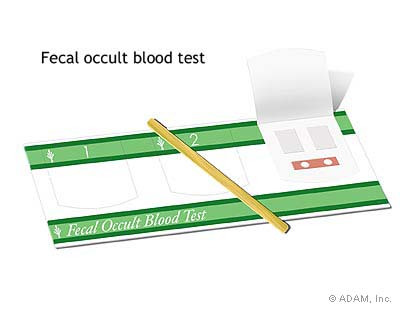 Fecel Occult Blood Test
This test involves testing for the presence of blood in the stool; the existence of blood good signify the growth of a polyp. It's recommended to perform this test at least once a year starting from 50-years-old. Testing is done by taking three stool samples. This may be done at home, with the purchase of a test kit from a pharmacy, or by a doctor. The samples are then either tested on a test card to see if there are any color changes or sent to be evaluated by a doctor. Certain restrictions apply to this test, though. A person shouldn't take this test if they have: diarrhea, colitis, constipation, diverticulitis, ulcers, hemorrhoids, or their period. As well, some foods may alter test results: beets, broccoli, cantaloupe, carrots, cauliflower, cucumbers, grapefruit, horseradish, mushrooms, radishes, red meats, turnips, and vitamin-C enriched foods.
Colonoscopy
This test involves the examination of the inside of a person's colon and rectum to evaluate pain or bleeding. Before the test, a person is required to withhold from solid foods; they may also be asked to take laxatives so that the colon may remain empty during the test. The test last for approximately thirty to sixty minutes while the person is given medicine to feel relaxed. the doctor would then insert a colonoscope to look for any abnormalities on the colon's lining. Any growths are then removed and taken for testing.
Virtual Colonoscopy
The colon is inflated and then CT scans are taken of a person's colon and then reconstructed into a 3D image. If any abnormalities are visible a person would then undergo a colonoscopy.
Other Test:
- Magnetic Resonance Imaging
- Radionuclide Screening
- Ultrasound
- Gene Testing (ex. for FAP)